
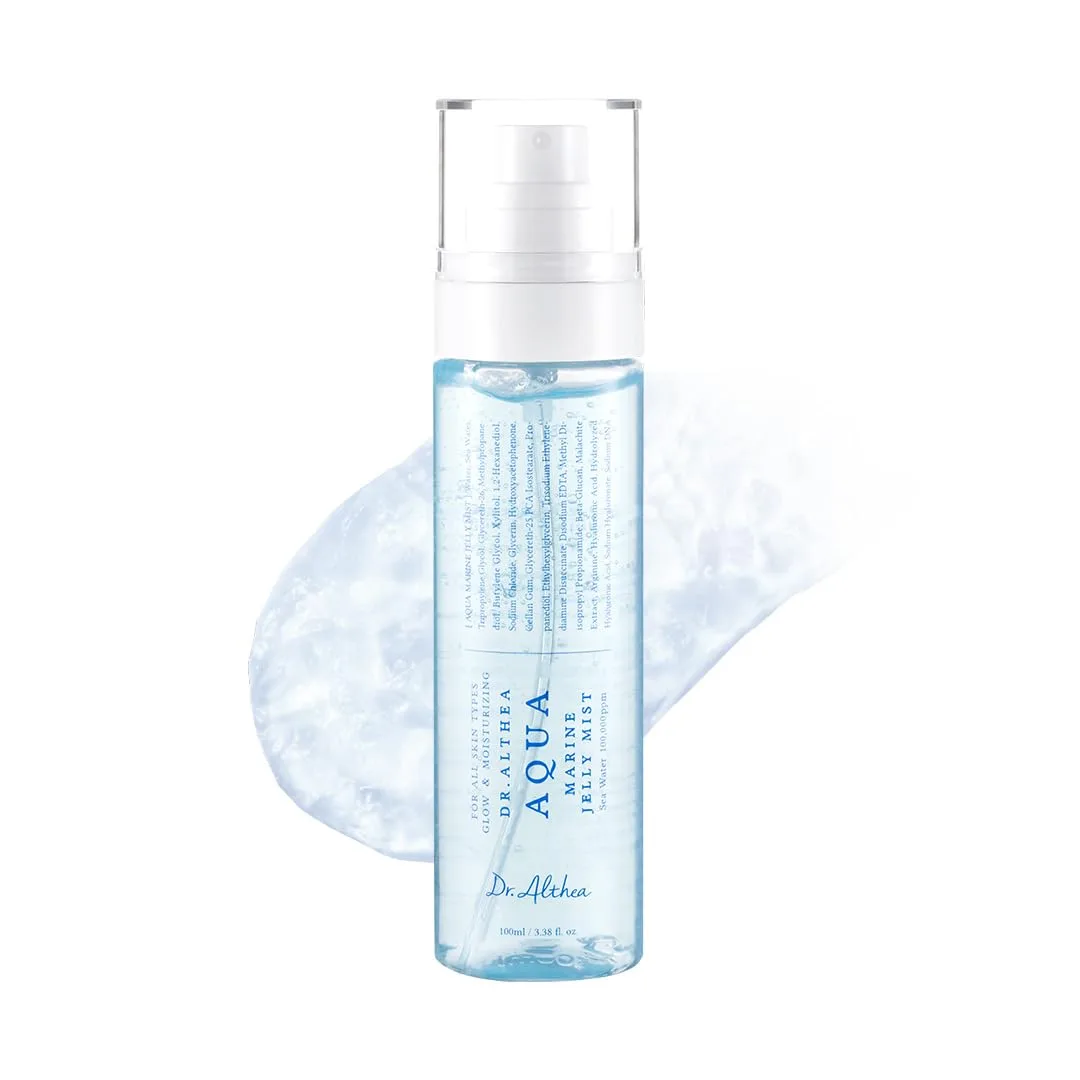
A new term is moving through English-language beauty coverage faster than the product it describes can be restocked. "Jelly mist" has shown up in headlines from Elle, Marie Claire UK, and Who What Wear within weeks of each other, each framing it as the next essential step in Korean skincare. The format itself is real: a gel-thick spray, somewhere between a toner mist and a serum, built with glycerin, glycols, and gums so the liquid clings to skin instead of beading off the way a water-based mist does. What gets less attention is how few products actually earn the label. Marie Claire UK and Who What Wear, in their own reporting, circle back to the same small cluster of items: Biodance's Collagen Peptide Jelly Serum Mist, a blue agave and rosewater toner spray from MIXIK, and a ginseng and centella mist from KrX Aesthetics. Three outlets covering a trend in the same month turns out to mean three outlets describing the same three bottles.
That narrowness says less about the products than about how a name travels. Biodance did not invent spray-on hydration; the brand built its reputation on a hydrogel sheet mask that went viral on TikTok for its bouncy, glass-like finish. The jelly mist is that formula philosophy moved into a faster delivery mechanism. A sheet mask asks for twenty minutes of stillness. A mist asks for one gesture, fitted into a commute or a bathroom-mirror routine in under ten seconds. The credibility a brand earns through one product category gets re-spent on a new one, and the English-language press has largely treated the new format as a fresh discovery rather than a line extension.
English-language writers have also blurred the jelly mist together with a different, older term that sounds almost identical. "Jello skin" is a 2022-era TikTok concept, popularized by creators like @glowwithava, describing bouncy, firm, collagen-plumped skin as a condition to aim for. Jelly mist is a product texture. The two got conflated partly because they share a word and partly because the earlier trend already trained audiences to associate "jelly" with Korean skincare credibility, making the new product name land as instantly familiar rather than as a coinage that needed explaining. That is language doing marketing's job before marketing has to.
The timing points to something bigger than one spray bottle. Through 2023 and 2024, the dominant finish in Korean skincare marketing was "glass skin," a term that described a poreless, highly reflective dewiness. Coverage tracking Korean platforms like Hwahae and Naver Beauty describes a shift, late in 2025, toward what outlets are calling "cloud skin" or "cloudglow skin," a softer, semi-matte finish with blurred pores rather than mirror shine. A jelly mist's selling point, plump but not greasy, with a blurred rather than glassy finish, maps directly onto that successor aesthetic. The format is not arriving at a random moment; it is arriving at the exact moment a new skin-finish vocabulary needs a product to point to.
There is also a trade story underneath the beauty-desk story. South Korea's cosmetics exports hit a record $11.43 billion in 2025, up 12.3 percent year over year, according to the country's Ministry of Food and Drug Safety. For the first time, the United States overtook China as Korea's largest export market, with US-bound shipments rising 15.1 percent to roughly $2.19 billion while China-bound shipments fell 19.2 percent to about $2.01 billion, per reporting from Korea JoongAng Daily and Personal Care Insights. Basic skincare, the category a jelly mist belongs to, led those exports at $8.54 billion. That shift in trade flow is a plausible reason three separate American lifestyle outlets went looking for a new K-beauty story in the same window: demand has structurally moved toward US shelves and US audiences, not just US algorithms.
What the coverage mostly skips is that no independent clinical or long-wear testing exists yet for any jelly mist. The most-cited data point, an ingredient-safety score of 99 out of 100 for the Biodance formula from the ingredient-checker site Skincarisma, measures the low-risk profile of the ingredient list, not whether the product delivers lasting hydration on skin. Most of what circulates as "coverage" is retailer product listings and affiliate roundups, repeating the same three names back to each other. None of that makes the texture a bad idea. A gel that clings instead of evaporating is a reasonable answer to a real problem with spray mists. But the gap between "three products exist" and "this is K-beauty's latest trend" is where a borrowed vocabulary word, cloud skin's rising cultural weight, and a viral brand's spare credibility are doing the heavy lifting that product testing has not yet done.
