Review
Sunscreens From AliExpress, Shein and Temu Failed Almost Every SPF Test
A French-led test of ten marketplace sunscreens found nine failed their SPF claims, with some labeled 50 measuring near zero protection, and three contained an EU-banned UV filter.
Published · Updated
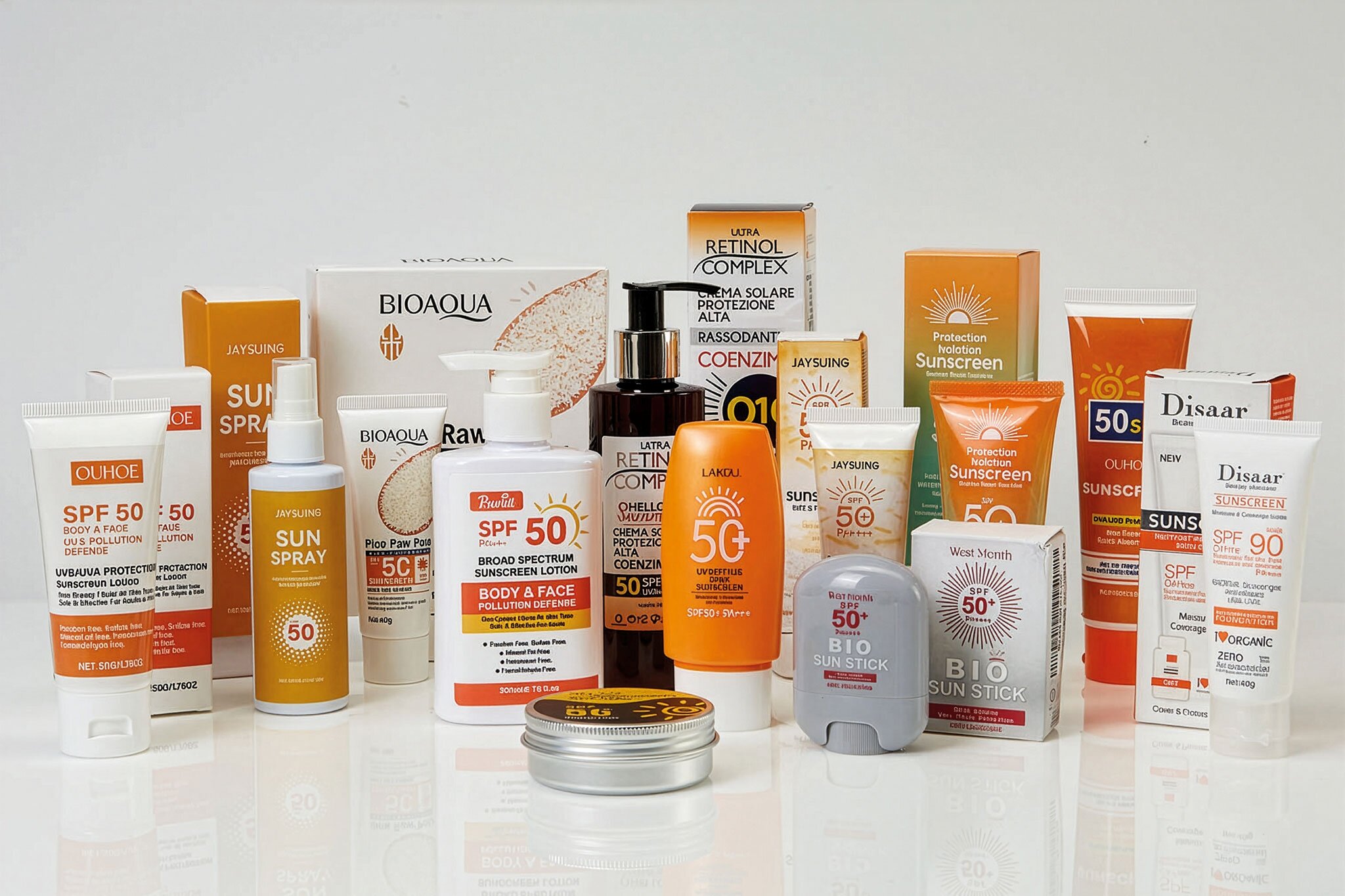
Ten sunscreens bought from AliExpress, Shein and Temu went into a lab this summer, and nine came out failing the one promise printed on the bottle: the SPF number. That is the headline finding from a test run by the French consumer group Que Choisir, working with partner organizations including Austria's VKI and Belgium's Test-Achats, and reported in German by Stiftung Warentest. The products, from brands including Sadoer, Bioaqua, Ouhoe, Jaysuing, Melao, Disaar, West Month, Laikou, Ruoall and LBLS, were bought exactly as any shopper would buy them, then checked against the claims on their labels.
The gap between claim and reality is what makes this a formula story rather than a marketing one. Six of the ten products delivered real-world protection 38 to 98 percent below their stated SPF. Some creams labeled SPF 50 measured out at SPF 1.2 to 1.6 in testing, a level indistinguishable from an unprotected face cream. A shopper applying one of these expecting all-day coverage at the beach would get, in practical terms, almost none.
Three of the ten contained 4-MBC, also known as enzacamene, a UV filter the EU has banned outright. The ingredient was moved off the bloc's approved list in April 2024 after the Scientific Committee on Consumer Safety flagged possible genotoxicity and hormone disruption tied to thyroid and estrogen activity. The ban on placing new stock containing 4-MBC on the market took effect 1 May 2025, and a full sales ban covering existing inventory began 1 May 2026, just weeks before this test was conducted. That timing matters for how the finding should be read: these are not old bottles slipping through on a technicality, they are listings that stayed sellable after the compliance deadline had already passed.
Only one product in the batch, Ouhoe Sunscreen 50, actually delivered its labeled SPF, a bottle bought for roughly 1.55 euros. It did so using octinoxate, also called ethylhexyl methoxycinnamate, an ingredient itself under suspicion as an endocrine disruptor. Even the single formula that passed the core performance test raised a separate ingredient concern, which is a useful reminder for anyone reading these results as a shopping list: passing on SPF and passing on safety are two different questions, and a product can clear one while missing the other.
A parallel Austrian round run by VKI showed how much of this story starts before a product ever reaches a lab. VKI ordered 14 sunscreens for its portion of the test, and only seven arrived in time to be tested at all, with others turning up late or never showing up. Three of those seven were excluded before formal testing because they contained 4-MBC. Of the four that made it through, VKI found none met the minimum protection standard printed on their packaging, regardless of whether the label said SPF 50, 50+, or 90. Packaging claims of 90, in particular, sit outside what dermatological testing bodies generally recognize as a meaningful or verifiable SPF tier, which is itself a signal worth noting on a bottle before it goes in a cart.
The platforms' responses to the findings diverged, and diverged from what Que Choisir's own follow-up checking found. Temu told the researchers it had temporarily suspended sales of similar sun protection products across the EU. Shein said it would open an internal audit of the sunscreen category. AliExpress said it had removed the specific tested items from its marketplace. When Que Choisir checked back, it found the AliExpress products still listed, now marked down as summer clearance stock. A removal claim and a live product page are not the same thing, and the second is what a shopper actually encounters when searching the site.
This test lands inside a broader run of scrutiny on the same three platforms. The European Commission fined Temu 200 million euros over Digital Services Act violations tied to unsafe and illegal products, including hazardous toys and electronics, with an action-plan deadline of 28 August 2026. Shein is separately under a DSA investigation opened by the Commission in February 2026, covering child-like sex dolls, addictive design features and its recommender systems. And on 1 July 2026, the EU ended the 150-euro duty-free threshold for small parcels, replacing it with a transitional flat handling fee per item category through mid-2028, a direct policy response to the volume of low-value packages these platforms ship into Europe. Sunscreen that fails its SPF claim is one visible symptom of a supply chain the EU is now trying to regulate on several fronts at once.
None of this is unique to marketplace sellers in kind, only in scale. Germany's Oekotest has previously found mainstream, shelf-brand sunscreens falling short of claimed SPF too, and has flagged banned plasticizers and octocrylene in some of them. What separates this result is the size of the miss: an SPF 50 label reading out at 1.2 in a lab is not a marginal underperformance, it is a product offering essentially no measurable protection while priced and marketed as full-strength sun care. For a buyer scrolling a marketplace listing with no dermatologist, no counter staff and no return policy worth the postage, the label is the only information available, and in nine of ten cases here, it was wrong.
