The Belly Button Was Not the Tell
Critics called Anne Hathaway's pregnancy fake and pointed to her navel as proof; medical documentation on belly button eversion, plus the timing of a separate AI-faked bump photo the same week, shows why that specific detail was the wrong evidence to use.
Published · Updated
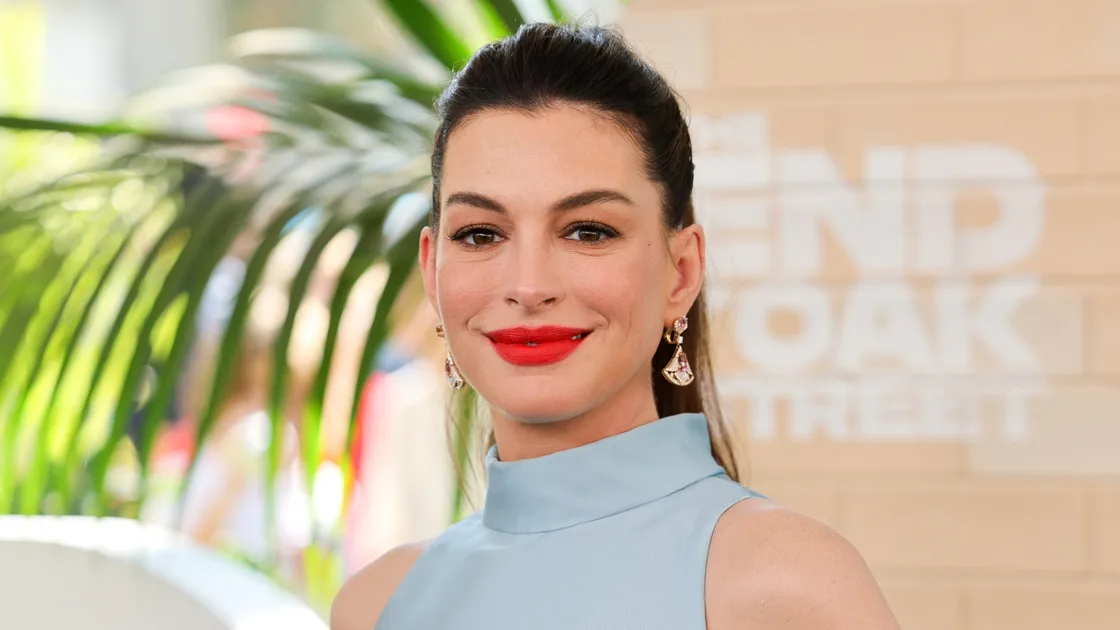
On August 9, outside the Warner Bros. lot in Burbank, a pregnant woman's belly button became the subject of forensic argument. Anne Hathaway, 43, arrived at the premiere of The End of Oak Street in a custom Atelier Prabal Gurung top: ice blue on the outside, a flash of crimson silk hidden in its lining, cut high-low with a cascading train, worn open at the stomach over low-rise jeans. Within hours, TikTok commenters had zeroed in on one detail.
I'm a woman and it looks like a fake preggo tummy, especially that belly button thingy.
I've seen countless pregnant women. Never one like this. Looks unnatural.
Hathaway, who announced the pregnancy, her third, on June 19, answered on Instagram the next day with a video captioned "Fake hair, real bump," dinosaur emojis attached.
The commenters were not wrong that the belly button looked unusual. They were wrong about what that meant.
What an outie actually documents
Belly button eversion, the medical term for a navel that pushes outward instead of staying tucked in, is one of the better documented physical markers of an advancing pregnancy. Cleveland Clinic OB-GYN Dr. Karmon James describes the mechanism plainly: growing fetal mass presses against the abdominal wall until "your belly button becomes an outie," typically "around 26 weeks." It is not universal. James is explicit that "it doesn't happen in every pregnancy, and there's no rhyme or reason to who gets" one, and that it can be neither predicted nor prevented. What it is not is evidence of an unnatural or constructed shape. It is closer to the opposite: a sign of real, uneven pressure from a real, growing uterus against real connective tissue.
Hathaway's is a third pregnancy. Her sons, Jonathan and Jack, are 10 and 6. Obstetric guidance on repeat pregnancies is consistent on one point: abdominal muscle that has already stretched once retains some of that laxity, so later pregnancies tend to show sooner, and more dramatically, than a first one did. A bump photographed roughly seven weeks after a June announcement, already prominent enough to bare at the waist, is not on its own suspicious. It is consistent with a documented pattern in multiparous women.
The week AI made this harder to read
Four days before the Burbank premiere, a separate baby bump photo, this one of Zendaya, was traced to a 2023 image and confirmed as AI manipulated: her actual, flat stomach digitally rounded, then shared across X and TikTok as real. That debunking landed on August 5. By August 9, anyone scrolling past Hathaway's premiere photos had spent the same week learning a bump could be manufactured entirely from pixels. The instinct to check was not unreasonable. It was aimed at the wrong kind of evidence. A synthetic image can be built to look anatomically plausible. It cannot easily reproduce the specific, unpredictable, medically unglamorous detail of an outie that, per Dr. James, has "no rhyme or reason."
None of this proves anything about a stranger's body from a red carpet photograph, and it should not have to. The narrower, more honest conclusion is this: the detail treated as damning evidence was, according to the people who study it for a living, closer to routine.
Sources: Cleveland Clinic
