The Stem Cells Leave Before This Scalp Serum Is Mixed
Hair Theory Lab's Future Vital Essence lists human hair follicle stem cell conditioned media, but the standardized term describes liquid collected after cultured cells have been removed. The label identifies a manufacturing origin, not the concentration or a proven hair-growth result in the finished serum.
Published · Updated
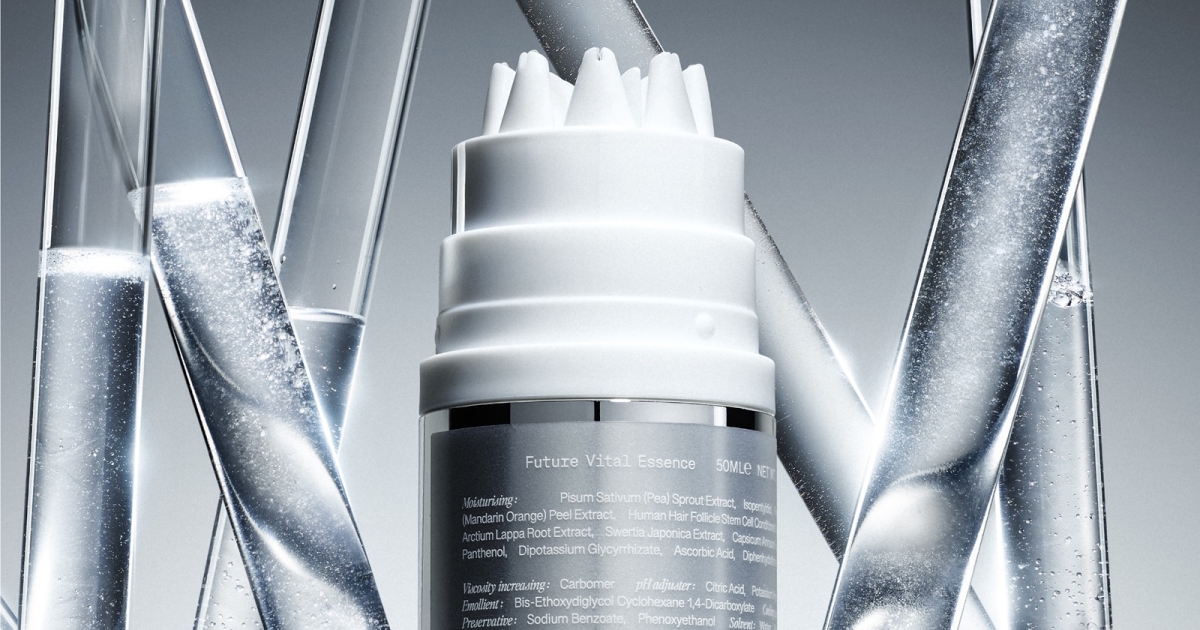
Hair Theory Lab surrounds Future Vital Essence with language about aging hair roots and the condition of future growth. Deeper in the formula, checked on August 12, 2026, sits an ingredient whose name can sound more consequential than its material form: human hair follicle stem cell conditioned media. It is listed after alpine flax, pea sprout, and mandarin peel extracts, and before a peptide and red clover extract.
Conditioned media is what the cells leave behind
The standardized ingredient definition describes a manufacturing process. Human hair follicle stem cells are cultured for several days, then removed. The remaining liquid is the conditioned media, meaning the culture environment has been altered by substances released while the cells were present. The named cosmetic ingredient is that collected liquid, not living stem cells suspended in the bottle.
This distinction does not make the ingredient inert, and it does not establish that it changes hair growth. Conditioned media can contain a shifting mixture of proteins and other cell-derived material. What survives processing, storage, and contact with skin depends on the raw material specification and the finished formula. Hair Theory Lab does not publish the ingredient's percentage or a specification for its conditioned media on the product page.
The ingredient list cannot supply the missing dose
Japanese cosmetic labels generally place ingredients in descending order, but components present at 1 percent or less may appear in any order. Eighth place therefore does not disclose a usable concentration. It only confirms that the standardized ingredient name is part of the declared formula.
The naming system has another limit. The Japan Cosmetic Industry Association says its Japanese display names are created from International Nomenclature of Cosmetic Ingredients names. It also states that inclusion in its list does not determine an ingredient's safety, and that safety or usefulness data are not required when a display name is requested. A formal-sounding name is identification, not product approval or clinical evidence.
The brand describes the serum itself as watery and quick-spreading, and confirms that it contains menthol. Cooling, fragrance, and the ease of moving the applicator across a towel-dried scalp are effects a user can observe promptly. Density, diameter, or shedding require a defined human study over time. The useful next question is not whether the bottle contains stem cells. It does not. Ask whether the finished serum has been tested in people, with the duration, sample size, comparison, and measured endpoints disclosed.
Sources: Hair Theory Lab product documentation · Hair Theory Lab FAQ · Japan Cosmetic Industry Association ingredient naming FAQ · Japan Cosmetic Industry Association labeling guideline
